



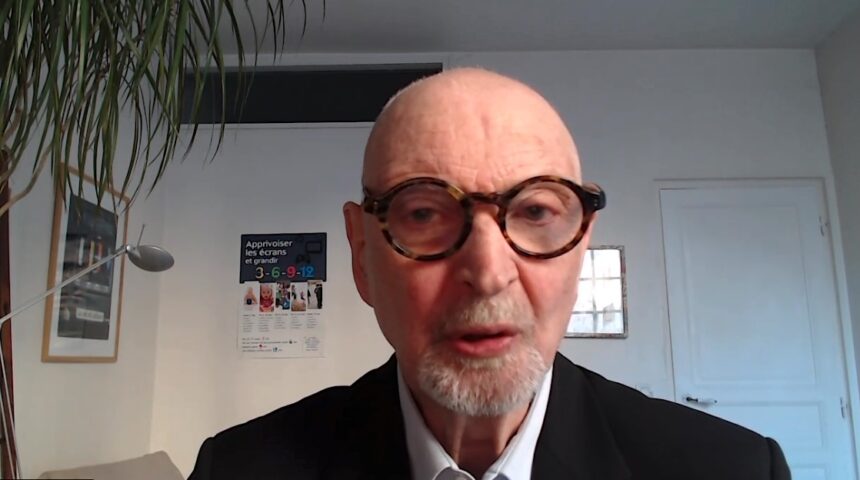
LUDOVIALES 2026 🎥 – During the conference held on Wednesday, March 18 as part of Ludoviales, Serge Tisserondelivered a deep and nuanced analysis of artificial intelligence, which he describes as an “uncomfortable social actor.” His talk goes beyond technical aspects to question our psychological, social, and educational relationship with these technologies.
A technology at the crossroads of two visions
From the outset, the psychiatrist reminds us that AI is not a uniform invention, but the result of two historical visions: that of John McCarthy, who saw it as a “universal problem solver,” and that of Alan Turing, for whom a machine is intelligent when it can pass as a human being.
Today, the meeting of these two definitions leads us to consider artificial intelligence as the equivalent of an extraordinary human being,” he explains.
This shift in perspective is not without consequences—especially in education, where AI is sometimes perceived as an authority figure.
An illusion of superiority… and a misleading one
For Serge Tisseron, one of the main risks lies in the illusion of competence created by these tools.
AI often gives us the impression that we are idiots,” he notes, highlighting their ability to produce complex and unexpected responses.
But this apparent intelligence hides a very different reality:
The way artificial intelligence works […] can produce statements that are logical, poetic, or completely absurd.”
Between biases, hallucinations, and unverified data, AI remains fundamentally imperfect—despite its apparent fluency.
Very real risks: bias, manipulation, and dependency
The researcher stresses the concrete dangers associated with AI, both technological and economic. These include:
- algorithmic bias, sometimes with serious consequences (especially in healthcare)
- the spread of misinformation
- user manipulation
- psychological dependency
He also points to a troubling phenomenon: many people seek in AI a kind of maternal substitute.
This emotional relationship can evolve into dependency, reinforced by systems designed to please users and capture their attention.
Anthropomorphism: key to our relationship with AI
At the heart of his analysis, Serge Tisseron highlights a fundamental psychological mechanism: anthropomorphism.
Humans tend to attribute human characteristics to machines,” he reminds us.
This phenomenon—already observed in the 1960s with the ELIZA program—helps explain why users trust systems that are, in reality, fallible.
Today, however, this tendency is amplified by design choices:
There is […] a deceptive anthropomorphism created by AI designers to keep us hooked.”
Not a tool, but a colleague
In response, the psychiatrist proposes a radical shift in perspective:
We must learn to treat AI as colleagues rather than tools.”
Why? Because unlike a traditional tool, AI is neither fully reliable nor predictable. It contains biases, errors, and its own internal logic.
Seeing it as a “colleague” would encourage a more critical stance—based on vigilance, dialogue, and distance.
A major educational challenge
Underlying his talk is a key question for education: how should we train students to interact intelligently with these systems?
Caught between fascination and mistrust, Serge Tisseron calls for collective awareness:
We cannot use AI as a simple tool […] because it is full of errors.”
A strong message at a time when AI is becoming increasingly integrated into teaching practices.
A deeply human reflection on AI
At Ludoviales, this talk stood out for its deeply human perspective on artificial intelligence. Far from techno-optimistic or alarmist narratives, Serge Tisseron invites us to rethink our relationship with these technologies: neither neutral tools nor intelligent beings, but ambiguous partners with whom we must learn to coexist.
About Serge Tisseron
Psychiatrist, PhD in psychology (HDR), member of the Academy of Technologies, creator of the 3-6-9-12 guidelines, the “Three Figures Game,” the Institute for the Study of Human-Robot Relationships (IERHR), and the Institute for the History and Memory of Catastrophes (IHMEC). He is also co-director of the University Diploma in Cyberpsychology at Université Paris Cité.
Recent publications:
- Empathy (PUF)
- Anger and Mourning: From an Intimate Emotion to Its Social Expression (Albin Michel)
- Should Social Media Be Banned for Young People? (Laffont)
Upcoming (April 2): Maternal Machines
Website: https://sergetisseron.com